ZATCA e-invoicing for travel agencies: Phase 2 and Wave 25 explained
Wave 25 brings many Saudi travel agencies into ZATCA Phase 2. Here is what changes for tickets, refunds and Umrah deposits, and how to be ready for FATOORA on time.


What LHDN's MyInvois rules mean for Malaysian travel agencies and tour operators, from phases and the exemption threshold to deposits, refunds, commissions and a readiness plan.
MyInvois e-invoicing for travel agencies is now part of everyday work in Malaysia. If your agency or tour company has an annual turnover of RM3 million or more, LHDN expects you to issue e-invoices through its MyInvois system, and the last implementation phase began on 1 January 2026. Smaller businesses below the exemption threshold are not required to take part, but they may join voluntarily.
This guide explains the rules in plain language for owners and finance managers of travel agencies, tour operators and Umrah operators. We cover the timeline, the MyInvois Portal and the API, validation and the QR code, the 72-hour cancellation window, consolidated and self-billed e-invoices, and how bookings, deposits, refunds and commissions fit in. We finish with a readiness plan, common mistakes and questions for your software vendor.
The short answer. Every sale your agency makes needs an e-invoice validated by LHDN, either one per customer or, where the rules allow it, one consolidated e-invoice for the month. Tour packages that include a flight cannot be consolidated, so most package sales need an individual e-invoice.
An e-invoice is a digital record of a transaction between a supplier and a buyer, sent to the Inland Revenue Board of Malaysia (LHDN, also called IRBM or HASiL) for validation. LHDN runs the MyInvois system, which checks each document in near real time and gives it a unique identifier. A PDF sent by email is not an e-invoice on its own. The document only counts once MyInvois has validated it.
E-invoicing replaces the paper and PDF invoices your agency issues today. It also covers the documents that adjust an invoice: credit notes, debit notes and refund notes. In some cases the buyer issues the document instead of the supplier, which LHDN calls a self-billed e-invoice.
LHDN explains the rules in two main documents. The e-Invoice Guideline sets out the general framework, and the e-Invoice Specific Guideline covers detailed cases such as consolidation, self-billing and foreign buyers. LHDN also publishes FAQs, including one for the tourism sector. Both guidelines have been revised many times, so always read the latest version on the LHDN website.
A travel agency issues many documents for one trip. A family Umrah package may start with a deposit, continue with instalments and end with a change of hotel or a partial refund. Each of these steps may need its own e-invoice or note, and each must carry correct buyer details. The work is less about the format and more about getting your booking data clean before it reaches MyInvois.
LHDN introduced e-invoicing in phases, based on annual turnover or revenue. The table below shows the phases on LHDN's implementation timeline. Your phase depends on your turnover in the reference year LHDN uses, so ask your tax adviser to confirm it.
| Phase | Annual turnover or revenue | Implementation date |
|---|---|---|
| Phase 1 | Above RM100 million | 1 August 2024 |
| Phase 2 | Above RM25 million up to RM100 million | 1 January 2025 |
| Phase 3 | Above RM5 million up to RM25 million | 1 July 2025 |
| Phase 4 | Up to RM5 million, above the exemption threshold | 1 January 2026 |
Source: LHDN e-Invoice Implementation Timeline. Check LHDN's latest guideline before relying on any date.
The exemption threshold has moved more than once. In December 2025 the government raised it from RM500,000 to RM1 million. LHDN's current e-Invoice Guideline and FAQ now say that businesses with annual turnover or revenue below RM3 million are exempt, following an announcement by the Prime Minister. No application to LHDN is needed to use the exemption.
There are limits. The guideline says the exemption does not apply in some cases, for example to a company that belongs to a group or is related to another business with turnover of RM3 million or more. If your agency is part of a group, check this point carefully with your adviser.
Businesses that started between 2023 and 2025 with turnover of RM3 million or more have an implementation date of 1 July 2026, according to the guideline. Businesses that start from 2026 follow separate rules linked to their start date and expected turnover. The guideline describes each case, so read the section that matches your situation.
For each phase, LHDN set an interim relaxation period after the start date. During this period, LHDN allowed more flexible practices, such as consolidated e-invoices for all transactions and simpler product descriptions, and said it would not impose penalties if the stated conditions were met. LHDN's 2026 newsletter describes the relaxation for the Phase 4 group as running until 31 December 2027. Check LHDN's latest guideline for the exact terms that apply to your phase.
Relaxation is not an exemption. You still need to issue e-invoices. It simply gives you time to fix data and processes before the full rules apply. LHDN has also announced a special voluntary disclosure programme for e-invoicing, running from 7 July 2026 until 31 December 2027, for businesses that want to correct past issues.
When you submit an e-invoice, MyInvois checks its structure and key details, such as the supplier's and buyer's tax identification numbers (TIN). If the document passes, MyInvois returns a unique identifier, the date and time of validation and the details needed to build a validation link. If it fails, you receive the errors and must correct the document and submit it again.
You then share the validated e-invoice with your customer. The visual copy, usually a PDF, must include a QR code that leads to the validation link. Your customer can scan it to check that the e-invoice exists and is valid on MyInvois.
After validation, there is a 72-hour window. Within it, the supplier can cancel a validated e-invoice, for example if it was issued in error, and the buyer can ask to reject it if the details are wrong. After 72 hours, you cannot cancel. You correct the position with a credit note, debit note or refund note instead.
For a travel agency, this window is short. A booking issued on a Friday evening may pass the window before anyone looks at it on Monday. Build a daily review of new e-invoices and rejection requests into your accounts routine.
Consolidated and self-billed documents work differently. A consolidated e-invoice is issued to the general public, so there is no buyer to reject it, and LHDN notifies only the supplier. For a self-billed e-invoice, the buyer issues the document, so the buyer is the party that cancels it.
LHDN offers two ways to send e-invoices. The MyInvois Portal is LHDN's web interface where you enter or upload invoices yourself. The API connects your own system to MyInvois, either directly or through an intermediary, such as a Peppol service provider or another technology provider. LHDN lets each business choose the method that suits it.

| Point | MyInvois Portal | API or intermediary |
|---|---|---|
| Entry | Manual entry or upload | Sent from your system |
| Best for | Low invoice volumes | High invoice volumes |
| Risk | Retyping errors | Mapping set up once |
For most travel agencies above the exemption threshold, manual entry does not scale. You would retype every booking, every deposit and every refund, and keep two records in step. The API route takes more work at the start, but the e-invoice then comes straight from the booking and its status sits on the invoice.
If a provider submits on your behalf, LHDN treats it as an intermediary. You authorise it on MyInvois, and it can only see the documents it submitted. You remain responsible for the content of your e-invoices, whichever route you use.
This is where the general rules meet the way a travel business sells. LHDN's tourism FAQ answers several travel questions directly. The points below summarise them in general terms. Your adviser should confirm how they apply to your contracts.
The answer depends on your contract with the airline, hotel or other supplier. If your agency buys a service and resells it in its own name, you act as principal, and you issue the e-invoice to your customer for the full price. If your agency only sells on behalf of the supplier, the supplier issues the e-invoice to the traveller, and your income is the commission.
For flights, LHDN's tourism FAQ gives an example. When the agency sells tickets only as the airline's agent, the airline issues the e-invoice and documents the agency's commission with a self-billed e-invoice. Review each supplier contract and record, in your system, which role you play for each product.
A tour or Umrah package is usually sold by your agency as one product at one price. In that case your agency issues the e-invoice to the customer. The FAQ also says that when a tour package includes a flight ticket, the agency cannot issue a consolidated e-invoice and must issue an individual e-invoice to each customer. Since most Umrah packages include flights, plan for an individual e-invoice per booking.
Deposits are common in travel, and LHDN treats them by their nature. According to the tourism FAQ, a refundable deposit does not need an e-invoice when you collect it. A non-refundable deposit does need an e-invoice at the time you collect it, and the balance is invoiced separately later. For instalment plans, agree with your adviser which payments trigger an e-invoice, and set your system to follow that rule every time.
Travel bookings change often. Within 72 hours of validation, you can cancel an e-invoice issued in error. After that, use the adjustment documents. A credit note reduces the amount of an earlier invoice, for example when a customer drops one traveller. A debit note increases it, for example when a customer upgrades a hotel. A refund note records money you pay back. Each note refers to the original e-invoice, so keep those links in your records.
Some customers do not ask for an e-invoice, such as a walk-in traveller buying a hotel night or a transfer. For these sales, you may issue a normal receipt and then combine the month's transactions into one consolidated e-invoice. The tourism FAQ says the consolidated e-invoice must be submitted within seven calendar days after the end of the month.
Consolidation has limits. The Specific Guideline lists activities that cannot be consolidated, and the tourism FAQ excludes flight tickets and packages that include a flight. If a customer asks for an individual e-invoice, you must issue one. The interim relaxation allowed wider consolidation for a time, so check which rule applies to you today.
Inbound tour operators and agencies near the border often sell to foreign customers who have no Malaysian TIN. The Specific Guideline provides a general TIN for this case: EI00000000020 for foreign buyers, other than MyPR and MyKAS holders. You still record the buyer's name and other details the guideline asks for, such as identification details where the guideline requires them.
Self-billing means the buyer issues the e-invoice on behalf of the supplier. LHDN allows it only in the cases listed in the Specific Guideline. In travel, two examples stand out. An airline may issue a self-billed e-invoice for commission it pays to an agent. A Malaysian agency that pays a foreign tour guide, who cannot issue a Malaysian e-invoice, issues a self-billed e-invoice for that service. A local guide issues an e-invoice to the agency instead.
Do not use self-billing simply because it is convenient. If a case is not on LHDN's list, the supplier must issue the e-invoice. Check each commission and supplier arrangement against the list.
E-invoicing is an income tax rule run by LHDN. Sales and Service Tax (SST) is a separate tax run by the Royal Malaysian Customs Department. Where your services are subject to SST, the e-invoice carries the tax details, but e-invoicing does not change whether SST applies. Ask your tax adviser how SST affects your packages, commissions and fees.
Related guideSales are not profit: how to read your travel agency profit and loss
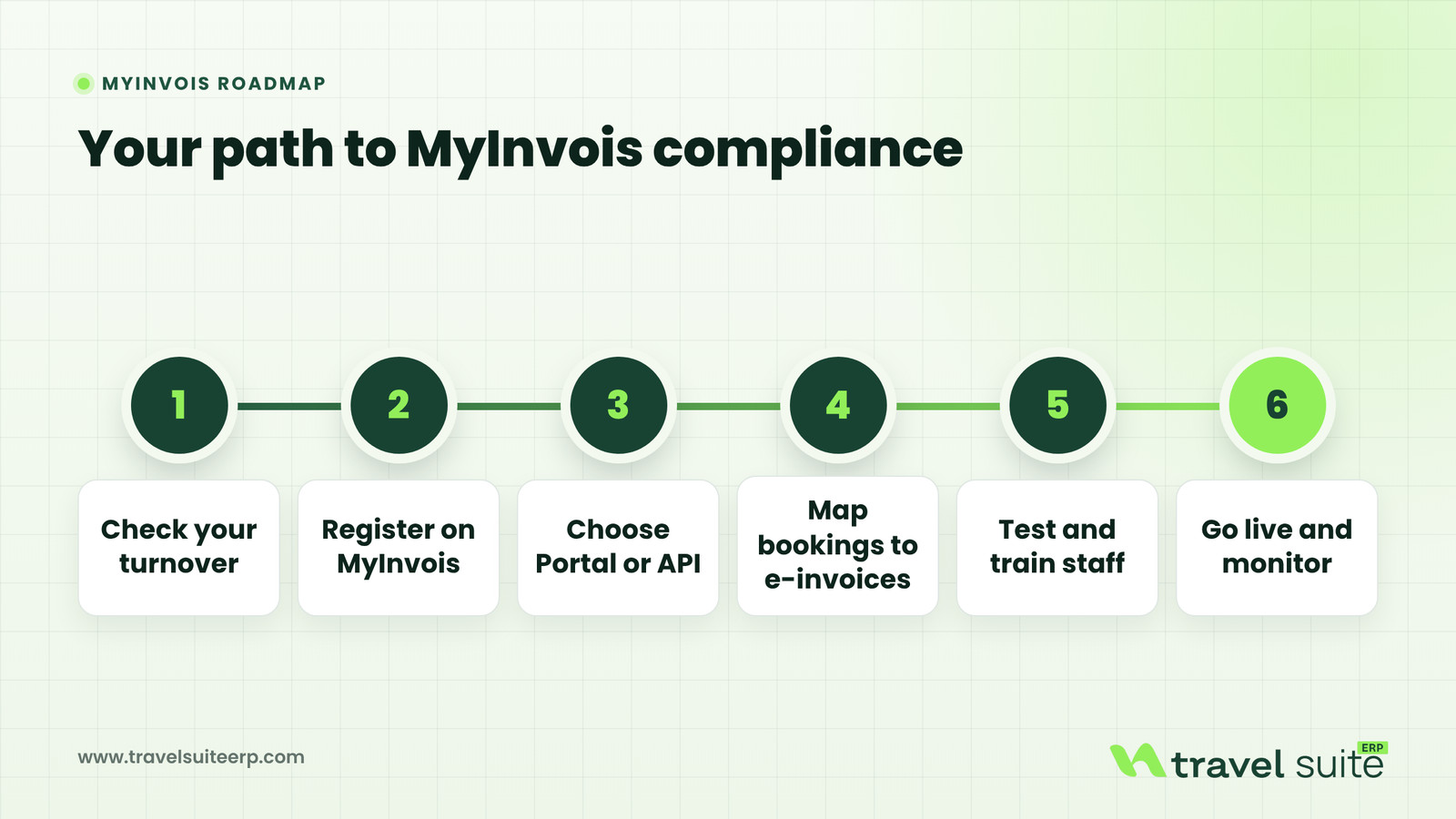
A clear plan saves weeks of corrections later. Use the steps below, in this order, whether you are joining now or tightening your process during the relaxation period.

Related guideTravel agency software: the complete buyer's guide for 2027
Related guideB2B travel agent commission: tracking sales from booking to payout
Your booking and accounting software decides how much of this work is automatic. Ask these questions before you commit, and ask to see each answer working on a travel example.
We are adding the MyInvois connection to TravelSuite ERP. Business plan customers in Malaysia get it as part of setup. Ask our team for the go-live date.
The aim is that your team keeps issuing invoices from bookings and quotations as it does today, for tour packages, hotels, visas, Hajj and Umrah and transport. TravelSuite ERP prepares the e-invoice in the LHDN format and submits it to MyInvois through your chosen connection: the MyInvois API, a Peppol access point or a middleware provider. Each invoice shows whether it is validated or rejected, with the unique ID, and validated invoices carry the QR code on the PDF.
The planned connection also covers credit, debit and refund notes, consolidated e-invoices for walk-in customers who do not need one, self-billed e-invoices where self-billing applies, a buyer TIN check before submission and the 72-hour cancellation window with the reason recorded. You still register on MyInvois with LHDN and authorise TravelSuite ERP to submit on your behalf, and our team helps with the setup.
Related guideZATCA e-invoicing for travel agencies: Phase 2 and Wave 25 explained
This article is general information, not tax or legal advice. LHDN's rules, thresholds and dates have changed several times and can change again, so check LHDN's latest e-Invoice Guideline, Specific Guideline and FAQs, or speak to a qualified tax adviser, before you act.
Sources
If you want to see how e-invoicing will fit into your bookings, invoices and accounts, book a demo or talk to our team about your MyInvois setup.
If your annual turnover or revenue is RM3 million or more, LHDN expects you to issue e-invoices through MyInvois, and all implementation phases have now started. Businesses below RM3 million are exempt under LHDN's current guideline, although the exemption does not apply in some group or related-company cases. You can still join voluntarily. The threshold has changed several times, so confirm your position against LHDN's latest guideline or with your tax adviser.
Only where LHDN allows it. You can usually give a receipt to customers who do not ask for an e-invoice, then submit one consolidated e-invoice within seven calendar days after the month ends. LHDN's tourism FAQ says flight tickets and tour packages that include a flight cannot be consolidated, so those sales need individual e-invoices. If a customer asks for an individual e-invoice, you must issue one.
After MyInvois validates an e-invoice, there is a 72-hour window. During it, the supplier can cancel the e-invoice, and the buyer can request a rejection if the details are wrong. Once the window closes, the e-invoice cannot be cancelled. Any correction is then made with a credit note, debit note or refund note that refers to the original e-invoice. A daily review helps your team act before the window ends.
The MyInvois Portal is LHDN's web interface. It suits businesses with few invoices, because each one is entered or uploaded by hand. The API connects your booking or accounting system to MyInvois, directly or through an intermediary such as a Peppol service provider. Travel agencies that issue many invoices, deposits and refunds usually find the API route more practical, because the e-invoice comes straight from the booking without retyping.
Foreign buyers usually have no Malaysian tax identification number. LHDN's Specific Guideline provides a general TIN, EI00000000020, for foreign buyers other than MyPR and MyKAS holders. You still record the buyer's name and the other details the guideline asks for, such as identification details where the guideline requires them. Check the latest Specific Guideline for the full list of required fields before you set up your templates.
We are adding the MyInvois connection to TravelSuite ERP. Business plan customers in Malaysia get it as part of setup, and our team configures it, connects your tax registration and tests the first invoices with you. You register on MyInvois with LHDN and authorise TravelSuite ERP to submit on your behalf. Ask our team for the go-live date for Malaysia before you plan your own timeline.

The TravelSuite team builds travel booking and ERP software for agencies in Bangladesh, Malaysia, the GCC and the USA.
Book a free 30-minute walkthrough with our team.
 Finance
Wave 25 brings many Saudi travel agencies into ZATCA Phase 2. Here is what changes for tickets, refunds and Umrah deposits, and how to be ready for FATOORA on time.
 Finance
Most of what customers pay you belongs to suppliers. Learn how to read your agency's P&L, find your real margins and close each month with confidence.
 Guides
What IATA accreditation lets your agency do, which model fits, the documents you need, how to apply step by step, and what changes once you settle through BSP.
Book a free walkthrough or message our team on WhatsApp.
 Need help?Chat on WhatsApp